Scissor Lift vs Forklift: Which Is Better for Your Warehouse Needs?
When comparing a scissor lift vs forklift for a warehouse, manufacturing facility, distribution center, or industrial workspace, the better choice depends on what your operation actually needs the equipment to accomplish. Although both can support safer, more efficient material handling, they are designed for very different tasks.
A forklift is primarily used to lift, transport, and stack palletized materials throughout a facility. A scissor lift table, on the other hand, is designed to raise and position loads vertically so employees can work with materials at a safer, more ergonomic height.
In many operations, the question is not necessarily whether a scissor lift table or forklift is universally better. Instead, it is about matching the equipment to the specific task.
If your team needs to transport pallets between receiving, storage, production, and shipping areas, a forklift may be appropriate. If workers repeatedly bend, reach, lift, or stretch to access parts and materials at a workstation, a scissor lift table may provide a more focused ergonomic solution.
Understanding the differences between these types of warehouse lifting equipment can help improve workflow efficiency, reduce unnecessary manual handling, make better use of floor space, and support a more productive working environment.
For businesses focused on ergonomic load positioning, Bishamon offers a complete selection of lift tables and hydraulic lift tables designed for warehouses, manufacturing facilities, assembly lines, packaging stations, and other industrial applications.
What Is a Scissor Lift Table?
A scissor lift table is a material handling platform that raises and lowers vertically using a crisscross scissor mechanism. Instead of lifting workers into the air, industrial scissor lift tables are typically used to raise materials, pallets, parts, tools, or components to a comfortable working height.
These tables are commonly used in warehouses, assembly lines, manufacturing facilities, packaging areas, maintenance departments, and production workstations. By positioning loads closer to the operator, scissor lift tables help reduce repetitive bending, lifting, reaching, and stretching during daily tasks.
Key scissor lift table features may include:
Vertical lift movement: Scissor lift tables move straight up and down, making them ideal for controlled height positioning.
Stable load support: Their platform design provides a stable surface for materials, components, cartons, pallets, or equipment.
Ergonomic positioning: Loads can be raised to the right working height to reduce strain and improve operator comfort.
Multiple configurations: Scissor lift tables may be stationary, portable, hydraulic, pneumatic, or mobile depending on the application.
Industrial durability: High-quality lift tables are designed for repeated use in demanding warehouse and manufacturing environments.
For operations that need flexible equipment throughout the facility, Bishamon also offers mobile lift tables designed for both load mobility and ergonomic positioning.
What Is a Forklift?
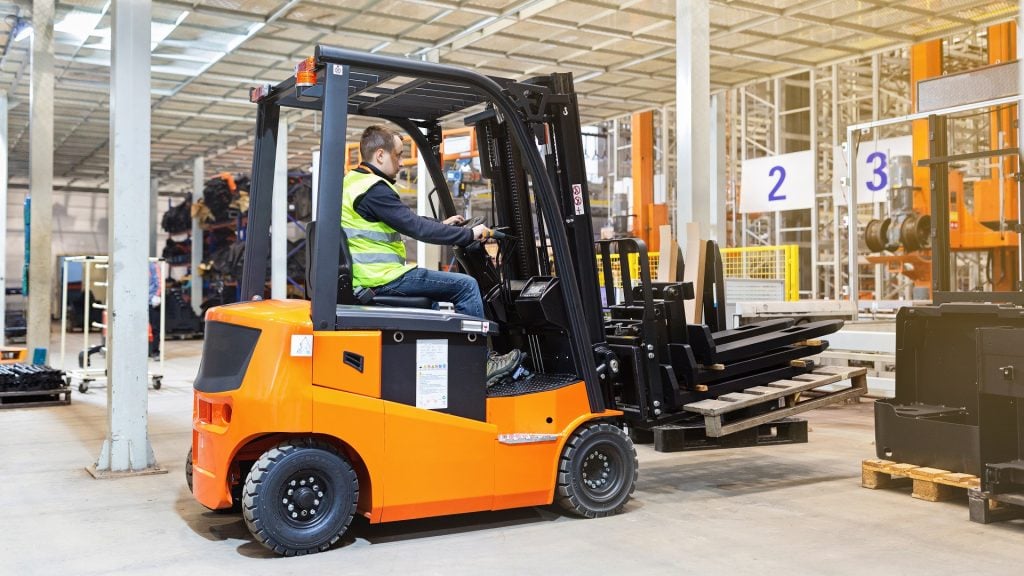
A forklift is a powered industrial vehicle designed to lift, carry, and stack heavy loads over short distances. Forklifts use front-mounted forks and a mast system to raise pallets, containers, and materials for transport, storage, truck loading, and racking applications.
Forklifts are commonly used in warehouses, distribution centers, manufacturing plants, loading docks, construction sites, and large industrial facilities. Unlike scissor lift tables, which are primarily used for ergonomic positioning, forklifts are designed for material transport and vertical stacking.
Common forklift features include:
Load lifting and transport: Forklifts can move heavy loads across a facility and place them onto racks, trucks, or storage areas.
High lifting capacity: Forklift capacities vary widely depending on the model, design, and application.
Mast and fork system: The mast raises and lowers the forks to lift pallets or materials to different heights.
Indoor and outdoor options: Forklifts may be electric, propane, diesel, or gas-powered depending on the work environment.
Operator training requirements: Forklifts require proper training, safe operating procedures, and ongoing inspections.
Forklifts are valuable for moving and stacking loads, but they are not always the best solution for repetitive workstation tasks where workers need comfortable access to materials throughout the day.
Scissor Lift Table vs Forklift: Key Differences
The biggest difference between a scissor lift table and a forklift is how the equipment is used. A forklift is designed to move and stack loads, while a scissor lift table is designed to position materials at an ergonomic working height.
A forklift may be the better fit when your operation needs to transport pallets across long distances, load and unload trucks, stack materials in racking, or move heavy loads between departments. A scissor lift table may be the better fit when workers need to repeatedly access parts, cartons, pallets, or materials at a workstation.
For example, a forklift can move a pallet to an assembly area, while a scissor lift table can help position that pallet at the correct working height once it arrives. In many facilities, these tools work together as part of a more complete material handling workflow.
Which Is Better for Your Application?
The right choice depends on your specific warehouse or industrial application. Before selecting equipment, consider the task, load size, available space, travel distance, lifting height, operator needs, and overall workflow.
Choose a scissor lift table when:
Your team needs to raise materials to a comfortable working height, reduce repetitive lifting, improve workstation ergonomics, support assembly tasks, improve packaging efficiency, or reduce worker fatigue during repetitive handling.
Choose a forklift when:
Your facility needs to transport heavy loads across longer distances, load and unload trucks, stack pallets in racking, move materials between departments, or handle large-scale warehouse logistics.
Consider both when:
Your operation needs forklifts for transport and lift tables for ergonomic positioning. Using both types of equipment can help improve material flow while reducing the physical strain placed on workers during loading, unloading, assembly, and packing tasks.
For lower-level pallet movement and warehouse transport, Bishamon’s pallet trucks and skid lifts may also support safer, more efficient material handling.
Factors to Consider When Choosing Equipment
Purpose
Scissor lift tables are best for ergonomic load positioning, workstation support, assembly, inspection, maintenance, and repetitive material access. Forklifts are best for transporting, stacking, and moving palletized goods across a facility.
Maneuverability
Forklifts are designed to move around a warehouse, navigate aisles, and transport loads. Scissor lift tables are typically used in a fixed location or moved only when needed, depending on whether the model is stationary or mobile.
Capacity
Forklifts are generally designed for heavier transport and stacking applications, while scissor lift tables vary by model and can support a wide range of material handling tasks. The right choice depends on your load weight, lift height, platform size, and daily use requirements.
Ergonomics
Scissor lift tables are often the better choice when the main goal is reducing worker strain. By lifting materials to a more natural working height, they help minimize bending, reaching, and manual lifting.
Space Constraints
In tight work areas, a compact lift table, mobile lift table, or pallet handling solution may be more practical than a forklift. Forklifts require room to maneuver, turn, and operate safely.
Cost and Maintenance
Forklifts are larger powered vehicles with higher purchase, maintenance, training, and operational costs. Scissor lift tables are often more focused tools for improving productivity and ergonomics at specific workstations.
Maintenance Tips for Scissor Lift Tables and Forklifts
Proper maintenance helps extend equipment life, improve safety, and reduce unexpected downtime.
For scissor lift tables, regularly inspect hydraulic systems, cylinders, seals, controls, platforms, safety features, and moving parts. Keep platforms clear of debris, follow lubrication schedules, and address any unusual movement, leaks, or wear before continued use.
For forklifts, inspect forks, masts, chains, tires, brakes, hydraulic systems, batteries, fuel systems, and warning devices. Operators should follow established inspection procedures before use and report equipment concerns immediately.
Whether you use a forklift, lift table, pallet truck, or skid lift, routine maintenance is essential for safe and reliable material handling.
Improve Material Handling With Bishamon Equipment
Bishamon provides innovative material handling equipment designed to improve workplace safety, ergonomics, and efficiency. From hydraulic lift tables and mobile lift tables to pallet trucks and skid lifts, our solutions help businesses move, lift, and position materials more effectively across warehouse, manufacturing, and industrial environments.
For operations that need to reduce worker strain, improve load access, or create a more efficient material handling workflow, Bishamon offers durable equipment built for long-term performance and value. Whether your facility needs ergonomic lift tables, pallet handling equipment, or mobile material handling solutions, Bishamon can help you identify equipment that supports safer and more productive operations.