11 Different Types of Pallet Jacks – Manual to Electric Types
From compact warehouse aisles to high-volume distribution centers, pallet jacks and pallet trucks are essential tools for moving palletized materials safely and efficiently. Choosing the right type of pallet jack can reduce unnecessary manual effort, improve load control, and help products move more efficiently through warehouses, manufacturing facilities, retail stockrooms, loading docks, and shipping departments.
There are many different types of pallet jacks, including manual, electric, rider, low-profile, narrow, multi-directional, and high-lift models. Each is designed for specific pallet sizes, load capacities, travel distances, floor conditions, and material handling applications.
Understanding the differences between pallet jack types can help you choose equipment that matches your facility without adding unnecessary size, cost, or complexity. For industrial pallet handling solutions, explore Bishamon’s complete selection of skid lifts and pallet trucks.
1. Manual Pallet Jack
A manual pallet jack, also called a hand pallet truck, is a manually operated tool used to lift and transport palletized loads. Its forks slide beneath the pallet, while a hydraulic pump activated through the handle raises the load enough for floor-level movement.
Manual pallet jacks are ideal for short travel distances, standard pallets, loading docks, delivery areas, stockrooms, and facilities with moderate daily handling requirements. Their straightforward design, maneuverability, and relatively low maintenance requirements make them a practical solution for many warehouse operations.
Bishamon’s Blue Label™ BS Series Hand Pallet Trucks are available in multiple capacities and fork configurations for demanding warehouse, manufacturing, and industrial applications. The series is designed for smooth rollability, long-term serviceability, and reliable daily pallet transport.
2. Electric Pallet Jack
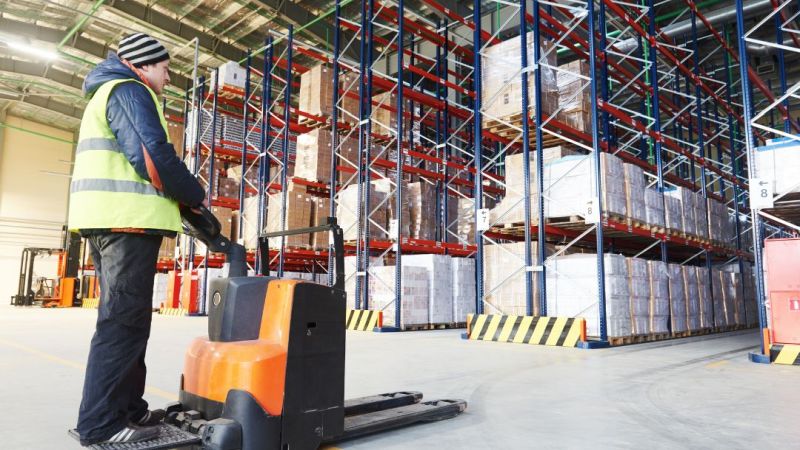
An electric pallet jack, powered pallet jack, or motorized pallet truck uses battery power to assist with lifting, travel, or both. Powered operation reduces the physical effort required to move heavy loads and can improve efficiency when pallets must travel longer distances.
Electric pallet jacks are commonly used in distribution centers, fulfillment facilities, grocery operations, manufacturing plants, and high-volume warehouses. They are particularly useful for repetitive workflows where operators move numerous pallets during each shift.
Facilities requiring powered pallet transport combined with elevated positioning can consider the UniLift® Electric Pallet Handler. The UniLift transports and raises standard GMA pallets, CHEP pallets, and skids without straddling the load, providing a compact alternative for applications that do not require a full-size forklift.
3. Rider Pallet Jack
A rider pallet jack is a powered pallet truck with an operator platform. Rather than walking behind the equipment, the operator rides on the unit while transporting loads across the facility.
Rider models are designed for large warehouses, distribution centers, logistics hubs, and other operations with long travel paths. By reducing the amount of walking required during each shift, they can improve travel efficiency and reduce fatigue in high-volume material handling environments.
A center rider pallet jack is a subtype that places the operator near the center of the unit. This configuration can provide improved visibility and control during frequent stops, direction changes, and repetitive pallet movement.
4. Weighing Scale Pallet Jack
A weighing scale pallet jack combines pallet transport with an integrated digital scale. Operators can lift, move, and weigh a load without first transporting it to a separate floor scale or weighing station.
These pallet trucks are useful for shipping, receiving, freight verification, order fulfillment, and inventory management. Combining weighing and transport into one process can reduce unnecessary handling steps and help teams verify shipment weights more efficiently.
Scale accuracy, maximum load capacity, fork dimensions, operating environment, and calibration requirements should all be evaluated before selecting this type of equipment.
5. Low-Profile Pallet Jack
A low-profile pallet jack has a reduced lowered fork height, allowing it to enter pallets, skids, containers, or equipment with less ground clearance than standard models.
Low-profile pallet trucks are often used for specialty pallets, custom containers, printing equipment, manufacturing materials, and imported pallets that cannot be accessed with conventional forks. Using the correct fork height can also help reduce the risk of damaging the pallet or load during entry.
The Blue Label™ BS Series includes multiple fork-height and size configurations, including a low-profile model for specialized pallet handling requirements. Facilities should compare the lowered fork height with the actual pallet opening before selecting equipment.
For additional sizing considerations, review Bishamon’s guide to standard pallet jack dimensions and fork measurements.
6. All-Terrain Pallet Jack
An all-terrain pallet jack is designed to transport palletized materials across rough, uneven, or outdoor surfaces. These models commonly use larger wheels, wider frames, and reinforced components to improve mobility on gravel, packed dirt, pavement, and temporary work surfaces.
All-terrain pallet jacks may be used at construction sites, farms, outdoor storage yards, landscaping operations, nurseries, and other locations where smooth warehouse floors are unavailable.
Before selecting an all-terrain model, consider the surface conditions, slopes, load weight, required travel distance, turning space, and whether the equipment will be used indoors, outdoors, or in both environments.
7. Adjustable Pallet Jack
An adjustable pallet jack has forks that can be repositioned to accommodate different pallet widths or load configurations. This added flexibility can help facilities handle custom pallets, specialty containers, and materials that do not use one consistent footprint.
Adjustable pallet trucks are useful in manufacturing plants, distribution centers, and warehouses that receive products from several suppliers using different pallet dimensions.
Operators must ensure that both forks are properly positioned beneath the load and that the selected configuration remains within the equipment’s rated capacity. Adjustable forks should not be treated as a substitute for equipment specifically engineered for oversized or unstable loads.
8. Narrow Pallet Jack
A narrow pallet jack uses a reduced fork spread or compact frame to handle smaller pallets and maneuver through confined spaces. These pallet trucks are useful in tight warehouse aisles, retail backrooms, delivery vehicles, compact storage rooms, and facilities where turning clearance is limited.
A narrower design can improve access, but the equipment must still provide adequate support for the pallet being moved. Fork spacing, pallet construction, load stability, aisle width, and turning radius should be reviewed together before choosing a narrow pallet truck.
Bishamon’s Blue Label™ Series is available with different fork widths and lengths, allowing facilities to select a configuration that more closely matches their pallet dimensions and available operating space.
9. Mini Pallet Jack
A mini pallet jack is a compact, lightweight alternative to a full-size hand pallet truck. It is generally intended for smaller pallets, lighter loads, delivery vehicles, retail stockrooms, and space-constrained handling applications.
Mini pallet jacks are easier to maneuver and store than larger warehouse models, but they may have reduced capacities, shorter forks, and smaller load wheels. Businesses should verify that the pallet footprint and total load weight fall within the equipment manufacturer’s specifications.
For standard industrial pallets or heavier daily workloads, a full-size hand pallet truck will generally provide greater capacity, load support, and long-term durability.
10. Multi-Directional Pallet Jack
A multi-directional pallet jack is designed to move laterally as well as forward and backward. Sideways travel can make it easier to position long, bulky, or unusually shaped loads in narrow aisles and congested work areas.
These specialized pallet trucks may be used for lumber, metal stock, rolled materials, oversized components, and other loads that are difficult to maneuver with a conventional pallet jack.
Multi-directional movement does not eliminate the need for sufficient clearance. Operators must still account for the complete load dimensions, center of gravity, floor conditions, pedestrian traffic, and available turning space.
11. High-Lift Pallet Jack
A high-lift pallet jack raises pallets or skids substantially higher than a standard hand pallet truck. In addition to transporting the load, it can elevate materials to a more comfortable working height for assembly, inspection, loading, unloading, packaging, and workstation tasks.
By bringing materials closer to the operator, high-lift pallet jacks help reduce repetitive bending, reaching, and manual repositioning. Pallet compatibility is especially important because some high-lift models are intended for open-bottom pallets and skids, while others can handle standard closed-bottom pallets.
Bishamon offers several high-lift pallet jacks and skid lifts for different applications:
Bishamon’s LV and LVE models support capacities up to 2,200 pounds and raised fork heights of 32.8 inches, while the UniLift reaches up to 36 inches unloaded and supports up to 2,000 pounds in high-lift mode, depending on load center.
How to Choose the Right Type of Pallet Jack
The best pallet jack for your facility depends on more than load capacity alone. Before selecting equipment, evaluate:
- Maximum pallet and cargo weight
- Pallet dimensions and bottom construction
- Required fork width and fork length
- Lowered and raised fork heights
- Daily travel distance
- Aisle width and turning space
- Floor and surface conditions
- Frequency of use
- Manual versus powered operation
- Whether the load must be elevated for workstation access
A manual pallet jack may be sufficient for occasional short-distance transport, while powered equipment may be more appropriate for repetitive movement or longer travel paths. Specialty models address specific challenges such as low-clearance pallets, restricted aisles, rough terrain, integrated weighing, and elevated load positioning.
Read Bishamon’s guide on how to choose the right pallet jack for your warehouse for additional selection guidance. You can also learn how much weight a pallet jack can lift and how high different pallet jacks raise a load before comparing models.
Explore Bishamon Pallet Jacks and Material Handling Equipment
Bishamon provides durable pallet handling equipment designed to help businesses move, lift, and position materials with greater control. The Blue Label™ Hand Pallet Truck Series supports dependable floor-level transport, while Bishamon’s high-lift pallet jacks provide elevated access for ergonomic loading and workstation tasks.
Operations that handle open-bottom pallets can explore the LV and LVE Skid Lift Series, while facilities working with standard pallets can consider the UniLift® Pallet Handler. Bishamon also offers pallet positioners for applications focused on improving access during pallet loading and unloading.